Set up
Company formation59 jurisdictions, one fixed price eachCrypto licensingExchange, custody and payment licences
See your price before you talk to anyone
Choose a jurisdiction and get a fixed quote.
By region
Europe
Africa and Indian Ocean

Citizenship by Investment in 2026
Five programmes are genuinely open this year, starting at USD 90,000. What each one costs once government and due diligence fees are added, who is eligible, and which are under regulatory pressure right now.
What citizenship by investment actually is
A statutory route to naturalisation. A government passes legislation permitting a person to be granted citizenship in exchange for a defined economic contribution, and administers applications through a dedicated unit. It is not discretionary and it is not a favour. The criteria are set out in law, the fees are published, and the decision sits with a named authority.
The route is commonly described in the market as obtaining a second passport. The passport is the document, not the thing being acquired. What is granted is citizenship, with the rights and obligations that carry with it, including tax and reporting consequences in the new country and in your existing one.

No residence in most cases
Several programmes require no physical presence at any stage. Others require a short visit for an oath or biometric enrolment.
Family inclusion
Spouses, children, and in several programmes parents, grandparents and siblings can be included in a single application.
Defined timelines
Processing is measured in weeks or months rather than the years typical of residence-based naturalisation.
Programmes are also distinct from immigrant investor programmes such as the United States EB-5, which lead to permanent residence rather than immediate citizenship. The wider field is known as investment migration.
These programmes are distinct from residency by investment, often marketed as a golden visa, which grants the right to live in a country rather than citizenship of it. Residency routes are generally cheaper and carry no immediate change of nationality. If a residence permit meets your objective, it is usually the better-value instrument.
The five programmes open in September 2026
Minimums shown are the lowest qualifying contribution before government and due diligence fees. Filter by region, or sort by cost or speed.
 Sao Tome and Principe
- Lowest entry point of any active programme
- No visit and no residence requirement
- Open to all nationalities except North Korea
 Vanuatu
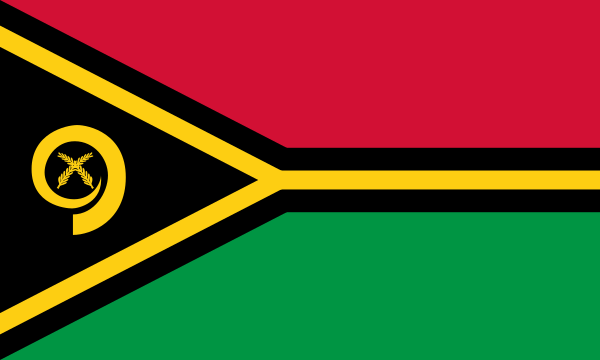
- Approval in weeks, not months
- No visit and no residence requirement
- No EU or UK visa-free access
 Grenada
- Only Caribbean programme with US E-2 treaty access
- Parents, grandparents and siblings admissible
- Russia, Belarus and North Korea excluded
 St Kitts and Nevis
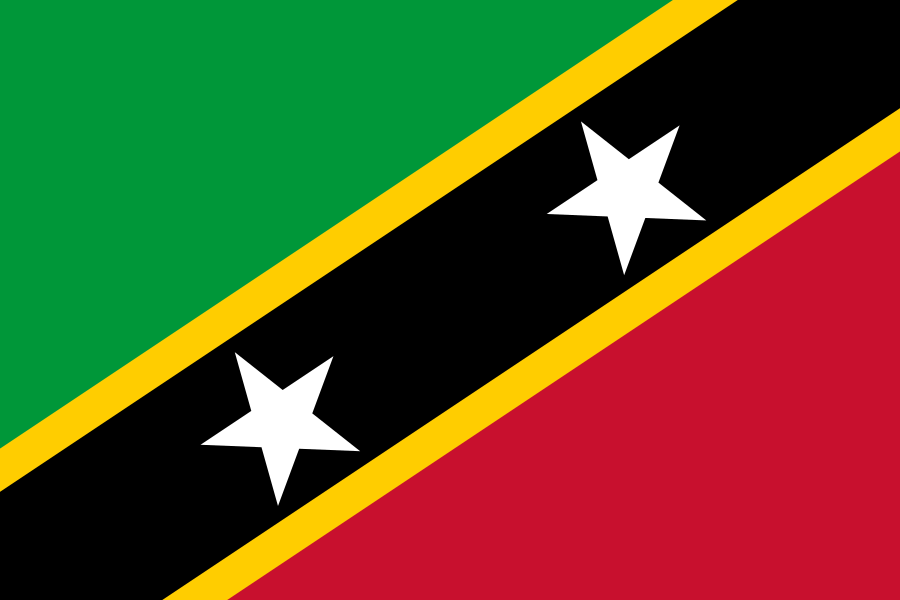
- The oldest programme, established 1984
- Widest travel access of the group
- Six nationalities excluded without exception
 Turkey
- Asset-backed rather than a donation
- Open to Russian and Belarusian nationals
- Not subject to the EU phase-out process
Not covered here: Dominica, Antigua and Barbuda, St Lucia, Nauru, Egypt, Jordan and Cambodia. Malta's programme closed following the European Court of Justice ruling of 29 April 2025. Spain's residency route ended 3 April 2025 and Cyprus closed in 2020.

The European Union has asked the Caribbean programmes to close by 2028
Regulation (EU) 2025/2441 entered into force on 30 December 2025. It amends the EU visa framework so that operating an investor citizenship scheme is, in itself, a ground for suspending a country's visa-free access to the Schengen area. Previously this required evidence of a specific security risk.
19 December 2025
The Commission's eighth report under the visa suspension mechanism named all five Eastern Caribbean states, citing roughly 107,000 passports issued and 10,573 applications in 2024.
25 June 2026
Letters were sent to the five states requesting that the programmes be phased out, with a transition period ending 1 June 2028.
Today
No programme has closed and no Schengen access has been suspended. The Caribbean governments have publicly indicated they intend to defend their programmes.
What this means for your decision
A Grenadian or Kittitian citizenship acquired today remains valid permanently. What is at risk is the visa-free access attached to it, which is a matter for the European Union and not for the issuing government. If Schengen access is your primary objective, price that risk in. If your objective is a stable additional nationality, banking access, or a base outside a single jurisdiction, the risk is materially lower.
What the programmes actually cost
The headline minimum is not the total. Every programme layers government processing fees, due diligence fees charged per person, and issuance fees. Due diligence is the largest of these and is charged whether or not the application succeeds.
Grenada
| Item | USD | Applies to |
|---|---|---|
| National Transformation Fund contribution | 235,000 | Single applicant or family up to four |
| Application fee | 1,500 | Per applicant, non-refundable |
| Processing fee | 1,500 / 500 | Aged 17 and over / under 17 |
| Due diligence fee | 6,000 | Per person aged 17 and over |
| Government contribution | 50,000 | Real estate route only |
A single applicant on the fund route comes to USD 244,000 all in. A family of four with two adults and two minors comes to USD 257,000. The real estate alternative requires a minimum USD 270,000 approved-project share held for five years, plus the USD 50,000 government contribution.
St Kitts and Nevis
| Item | USD | Applies to |
|---|---|---|
| Sustainable Island State Contribution | 250,000 | Single applicant or family up to four |
| Approved developer real estate | 325,000 | Alternative route, seven-year hold |
| Approved private home purchase | 600,000 | Alternative route, seven-year hold |
| Due diligence fee | 10,000 | Main applicant |
| Due diligence fee | 7,500 | Each dependant aged 16 and over |
| Additional dependant, under 18 | 25,000 | Beyond the family-of-four contribution |
| Additional dependant, 18 and over | 50,000 | Beyond the family-of-four contribution |
| Post-approval addition of spouse | 30,000 | After citizenship granted |
Due diligence fees are payable on submission. The main contribution is payable only after approval in principle.
Turkey
Turkey does not publish a consolidated per-applicant fee schedule in the way the Caribbean units do. The qualifying investment is USD 400,000 in approved real estate, carrying a three-year restriction on sale recorded on the title deed. Alternative routes are USD 500,000 held for three years as a bank deposit, government bonds or fixed capital investment, or the creation of fifty jobs for Turkish citizens.
Transactional costs sit outside the investment itself: a 4 percent title transfer fee, an SPK-licensed valuation report, residence permit and application fees, and translation and notary costs. The property value must be independently established by appraisal, and the purchase price paid through documented banking channels. Cash is not accepted.
Sao Tome and Principe
| Item | USD |
|---|---|
| Submission fee, any family size, non-refundable | 5,000 |
| Donation, single applicant | 90,000 |
| Donation, family of two to four | 95,000 |
| Each additional dependant from the fifth | 5,000 |
| Passport issuance, per person | 350 |
| National identity card, per person | 150 |
| Certificate of registration, per person | 250 |
The donation is payable within ninety days of approval in principle, so only the submission fee is at risk on refusal. A single applicant comes to USD 95,750 all in.
Vanuatu
| Applicant composition | Contribution, USD |
|---|---|
| Single applicant | 130,000 |
| Applicant and spouse | approx 150,000 |
| Family of four | 180,000 to 186,000 |
| Due diligence fee | 5,000 to 5,500 |
Reconstructed from authorised agent restatements. The Vanuatu Citizenship Commission does not currently publish a readable consumer fee schedule, so these should be confirmed in writing before any commitment is made.
The point most applicants get wrong
Due diligence fees are paid before approval and are not returned if the application fails. On a family of four applying to St Kitts and Nevis that is USD 25,000 at risk before any investment is made. Anyone with a complicated background, a refused application elsewhere, or funds that cannot be cleanly documented should resolve that before submitting, not during.
The application process, step by step
The sequence is broadly consistent across programmes, though the order of payment differs and matters a great deal to your risk exposure.
Preliminary assessment
Nationality, family composition and background are checked against the target programme's eligibility rules before any fee is paid. This is where most unsuitable applications should be identified.
Source of funds preparation
Documentary evidence of how the investment funds were earned or acquired. The most common cause of delay and refusal, and the stage that most rewards preparation.
Submission through a licensed agent
No programme covered here accepts direct applications from the public. Every file is submitted by an agent licensed in that jurisdiction.
Due diligence
Conducted by the government unit, usually with an external screening provider. Fees are paid at this stage and are not refunded if the application is refused.
Interview where required
Mandatory for main applicants in St Kitts and Nevis. Conducted remotely as part of due diligence in Grenada.
Approval in principle
The government confirms the applicant has passed due diligence and invites payment of the qualifying investment.
Investment payment
Made after approval in principle in most programmes, which limits your exposure if the file is refused.
Certificate and passport issuance
Collection arrangements vary. St Kitts and Nevis requires collection in person in the country or at a designated embassy.
Due diligence and source of funds
Every programme covered here operates enhanced due diligence, and the standard has risen sharply since 2024. The Financial Action Task Force and the OECD published a joint report in November 2023 identifying investment migration as a money laundering risk and, importantly, extending that concern to the intermediaries and professional advisers involved, not only to applicants.
Police clearance
From every country of citizenship and every country of residence over a defined lookback period.
Source of wealth
Documentary evidence of how your overall net worth was accumulated, not only the sum being invested.
Source of funds
Separate evidence of the specific origin of the money being invested, traced through banking channels.
Prior refusals
Disclosure of any previous visa or citizenship refusal, anywhere. Non-disclosure is treated more seriously than the refusal itself.
Screening providers share data across programmes, and the Caribbean units share denied-applicant information with each other through a regional mechanism. An undisclosed refusal in one country will surface in another.
As a licensed corporate services provider supervised by the UAE Ministry of Economy, Sovera conducts its own customer due diligence before any file is prepared. That is a regulatory obligation on us, independent of what the destination government requires.
Nationality restrictions by programme
The first question that should be asked, and the one most published material answers badly. Several programmes exclude specific nationalities outright. Applying to a programme that excludes you wastes a non-refundable due diligence fee.
St Kitts and Nevis
Nationals of, and persons ordinarily resident in, Russia, Belarus, North Korea, Afghanistan, Iraq and Iran are excluded without exception, under the Exclusion Order published 27 July 2023.
RestrictedGrenada
Russia, Belarus and North Korea are ineligible. Iran, Afghanistan, Sudan and Yemen are conditional, generally requiring emigration before eighteen and long residence in an approved jurisdiction.
RestrictedTurkey
Property purchase is restricted for a small number of nationalities, most consistently Syria, Armenia and North Korea. Turkey publishes no single official list, so confirm for the specific nationality before proceeding.
Check firstVanuatu
Six nationalities face enhanced due diligence. A notice appearing to add Russia and Sudan was issued on 9 March 2026 and formally withdrawn on 11 March 2026 as released in error. Russian nationals remain eligible.
OpenSao Tome and Principe
Open to all nationalities other than North Korea.
OpenUAE Golden Visa
Residence rather than citizenship. No nationality restriction of any kind.
OpenIf you hold Russian or Belarusian nationality
The Caribbean programmes are closed to you. The routes that remain open are Turkey, Vanuatu, and Sao Tome and Principe, together with residency programmes including the UAE Golden Visa, which carries no nationality restriction.
Choosing between the programmes
The right programme follows from the objective, and most applicants have not defined the objective precisely enough before shopping on price.
| If your objective is | Consider | Reasoning |
|---|---|---|
| Lowest total cost | Sao Tome and Principe | Lowest entry point of any active programme, fully remote, but no major-market travel access |
| Speed | Vanuatu, Sao Tome and Principe | Both process in weeks rather than months, neither requires a visit |
| A US treaty investor route | Grenada | The only Caribbean programme whose citizens can apply for a US E-2 visa, subject to a qualifying residence period |
| Broadest travel access | Grenada, St Kitts and Nevis | Widest access of the group, subject to the European position set out above |
| Family across generations | Grenada, St Kitts and Nevis | Both admit parents and grandparents, and Grenada admits siblings, subject to dependency criteria |
| Low-tax base without changing nationality | UAE Golden Visa | Ten-year renewable residence, no nationality restriction, self-sponsored |
If the objective is tax, the answer is frequently not citizenship at all. Acquiring a nationality does not by itself change tax residence, and for a United States citizen it changes nothing until expatriation. Establish your tax position with a qualified adviser in the relevant jurisdictions before applying, not after.
How Sovera handles these applications
We prepare files, manage source of funds documentation, run pre-submission compliance checks, and submit through licensed agents in each jurisdiction. Our role is to get a file to the standard a government unit will accept first time, and to tell you honestly when a programme is unsuitable for you.
We do not quote professional fees on this page. Fees depend on family composition, nationality, and the complexity of the source of funds position, and quoting a headline number that does not survive contact with an actual file is not useful to anyone. Fees are set out in writing before any engagement begins.
Sovera Global L.L.C-FZ is a licensed corporate services provider regulated in the Meydan Free Zone, Dubai, and supervised by the UAE Ministry of Economy under Commercial Licence 2531729. We are not a Citizenship by Investment Unit Authorised Agent in any jurisdiction. Applications are prepared by us and submitted through licensed Authorised Agents in the relevant country. All approvals are at the sole discretion of the issuing government and are subject to due diligence. No outcome is guaranteed and no timeline is promised. Nothing on this page is legal or tax advice.

Frequently asked questions
Is citizenship by investment legal?
Yes. Each programme covered here is established by national legislation and administered by a designated government authority. Grenada operates under its Citizenship by Investment Act and 2024 amending regulations, St Kitts and Nevis under its Citizenship by Investment Act 2024, Turkey under Citizenship Law No. 5901, and Sao Tome and Principe under Decree-Law No. 07/2025.
Do I have to give up my current citizenship?
None of the programmes covered here requires renunciation. Whether you may hold dual nationality depends on the law of your existing country of citizenship, not on the programme. Several countries restrict or prohibit it, so this must be checked against your own nationality law first.
Do I have to live in the country?
No programme covered here imposes a residence requirement. St Kitts and Nevis requires attendance to collect documents, in the country or at a designated embassy. Turkey requires a short-term residence permit as a procedural step. Grenada, Vanuatu and Sao Tome and Principe require no visit at any stage.
How long does it take?
Grenada targets sixty business days from submission. St Kitts and Nevis runs to approximately 160 to 180 days. Vanuatu processes in thirty to sixty days. Sao Tome and Principe targets six weeks, though the first cohort averaged closer to two and a half months. Turkey runs four to eight months. None of these is guaranteed, and due diligence complexity is the main variable.
Can my family be included?
Yes. All programmes admit a spouse and dependent children. Grenada and St Kitts and Nevis also admit parents and grandparents subject to age and dependency criteria, and Grenada admits siblings. Additional dependants beyond the base family size carry additional contributions, set out in the fee tables above.
What happens if my application is refused?
Due diligence and processing fees are not refunded. The qualifying investment is generally payable only after approval in principle, so the main financial exposure on refusal is the fee layer rather than the investment. A refusal must be disclosed on any subsequent application to any programme.
Which programmes are open to Russian and Belarusian nationals?
Of the programmes covered here, Turkey, Vanuatu, and Sao Tome and Principe. Grenada and St Kitts and Nevis exclude both nationalities. The UAE Golden Visa, which grants residence rather than citizenship, carries no nationality restriction.
Will these programmes still exist in five years?
A citizenship already granted is permanent and is not affected by a programme closing. Whether new applications will still be accepted is less certain for the Caribbean programmes, given the European Commission's request that they be phased out by 1 June 2028. Turkey and the UAE are not subject to that process.
Can I apply directly to the government myself?
No. Every programme covered here requires submission through an agent licensed in that jurisdiction. Governments do not accept applications from members of the public.
Which is better, Grenada or St Kitts and Nevis?
Grenada costs less at $235,000 against $250,000, admits siblings as well as parents and grandparents, and is the only Caribbean programme offering access to the US E-2 treaty investor visa. St Kitts and Nevis is the older programme, established in 1984, with broader travel access and a stronger brand. Both exclude Russian and Belarusian nationals. For most applicants Grenada is the better value; for those prioritising prestige and travel breadth, St Kitts.
Is citizenship by investment cheaper than a golden visa?
Not usually. Residency by investment programmes such as the UAE Golden Visa or Greece grant the right to live in a country without changing nationality, and generally cost less than citizenship. Citizenship by investment starts at $90,000 in Sao Tome and Principe, while several residency routes start lower. If a residence permit meets your objective, it is normally the better-value instrument.
How does citizenship by investment differ from naturalisation?
Ordinary naturalisation requires years of physical residence, and in most countries a language or civics test. Citizenship by investment substitutes a defined economic contribution for that residence period, and is granted under separate legislation administered by a dedicated government unit. The citizenship itself is identical once granted.
Which programme is best for a family of four?
Grenada and St Kitts and Nevis both cover a family of up to four within the base contribution, at $257,000 and $267,500 all in respectively. Sao Tome and Principe covers a family of four for $103,000 including fees but offers no European or North American travel access. The right answer depends on whether travel access or cost is the binding constraint.
Many clients pair a second citizenship with a corporate structure. See our company formation service across 59+ jurisdictions, Dubai company formation for a low-tax operating base, business banking introductions, and compliance and accounting support. For the Grenada programme in detail, see our Grenada citizenship by investment guide.

Find out which programme you actually qualify for
A thirty-minute call establishes your eligibility, the realistic total cost for your family composition, and whether citizenship is the right instrument at all. No fee, and no obligation.